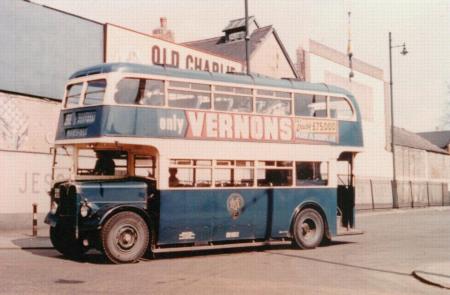
An unidentified ONU in service with Midland General on route B8 (Mansfield to Nottingham)
In 1950, Midland General was owned by the British Transport Commission. An order for 30 Weymann lowbridge bodied, AEC Regent III chassis double deckers was outstanding; but only 10 of these were required and delivered (the remaining 20 were offered to London Transport, thus forming the first batch of RLHs). These became UK Registration Numbers ONU 630-639, delivered in 1950.
The ONUs were generally garaged at Mansfield (Sutton Road), which was extended in 1952. On occasion, they visited Langley Mill garage (Station Road) for repairs. However, it is thought that 421 to 426 were the only vehicles allocated to Mansfield initially, with the remaining vehicles 427 to 430 coming later.
An unidentified ONU in service with Midland General on route B8 (Mansfield to Nottingham)
The bridge that necessitated use of lowbridge vehicles was just south of Bestwood village. It carried a railway branch line, from Nottingham (Midland) to Mansfield and Worksop line, into Bestwood colliery (grid reference SK549472).
The ONUs were withdrawn in 1968, probably being replaced by Bristol Lodekkas.
It is known that these lowbridge buses ran on at least the following routes:
The buses also ran on other routes, but these were also served by highbridge vehicles.
See the following pages:
From recollections, interior differences of the 'ONU's compared to the first batch RLHs were:
From photographs and recollections, exterior differences were:
The following exterior changes were made after a few years service to some (if not all) vehicles:
The following two batches were also on the AEC Regent III chassis, but had Weymann highbridge (instead of lowbridge) bodies:
| Qty | UK Reg No. | Operator and fleet no. | Weymann body no. | AEC Chassis no. | Seating config | Date new |
|---|---|---|---|---|---|---|
| 15 | MRB 29- 43 | Midland General 27, 28, 86-91, 108, 109, 116-120 | M3679- M3693 | 9612E 3725- 3739 | H30/ 26R | 1948 |
| 18 | JVO 931- 936, 938- 946, 948, 949, 951 | Mansfield & District 135-140, 142-150, 152, 153, 155 | M3694- M3711 | 9612E 3705- 3710, 3712- 3720, 3722, 3723, 3747 | H30/ 26R | 1948, 1949 |
An earlier AEC Regent II (0661 type) chassis was also fitted with both lowbridge (but with a smaller cab window than the RLH) and highbridge Weymann bodies as follows:
| Qty | UK Reg No. | Operator and fleet no. | Weymann body no. | AEC Chassis no. | Seating config | Date new |
|---|---|---|---|---|---|---|
| 10 | GRR 337- 346 | Mansfield & District 115-124 | M2696, M2697, M2699- M2701, M2726- M2728, M2748, M2749 | 0661/ 7451- 7460 | H30/ 26R | 1946 |
| 15 | GRR 347- 361 | Mansfield & District 61-75 | M2792- M2806 | 0661/ 7593- 7607 | H30/ 26R | 1946 |
| 8 | KNU 601- 608 | Midland General 60, 63, 64, 70, 71, 75-77 | M2908- M2915 | 0661/ 7733- 7740 | H30/ 26R | 1946 |
| 15 | HVO 931- 945 | Mansfield & District 120-134 | M3337- M3351 | 0661/ 7994- 8008 | H30/ 26R | 1947 |
| 10 | KRB 71- 80 | Midland General 121-125, 157, 159, 160, 162, 168 | M3352- M3361 | 0661/ 8014- 8023 | H30/ 26R | 1947 |
| 5 | KRB 81- 85 | Midland General 416-420 | M3362- M3366 | 0661/ 8009- 8013 | L27/ 26R | 1947 |
NB There were also various other Regents acquired from independent companies, but they did not have Weymann bodies.
The Midland General Omnibus Company (MGOC) was formed in 1920 as a subsidiary of the Nottinghamshire and Derbyshire Tramway Co., and began operating bus services two years later. It operated in an area within and surrounding Derbyshire. Within 7 years, it had become the largest operator within the Midland General Group, after which it continued to expand.
The Midland General Group was owned by the Balfour Beatty group (an important member of the electricity supply industry). The Group composed of three operators:
MGOC and N&D buses were liveried in blue and cream whilst M&D buses wore green and white.
When the electricity industry was mostly nationalised in 1948, Balfour Beatty sold the Midland General Group also, to the British Transport Commission. The ONU buses were in fact the last buses ordered by Balfour Beatty, although they were not delivered until 1950 when the BTC was in charge. The three operators then became known as part of the Tilling group. There were no more new buses delivered to MGOC or N&D until 1953.
After the formation of the National Bus Company the Group was split up between Trent Motor Services (taking N&D) and East Midland Motor Services (taking M&D) at the start of 1969. However, the Midland General fleet were allowed to continue to run in their blue colour scheme, which was unusual as most NBC companies took the corporate livery.
Soon afterwards, at the end of 1971, MGOC was also absorbed: this time into Trent Motor Services.
The trading name Midland General has been used since.
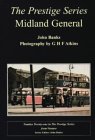
the Prestige Series No. 21: Midland General
by John Banks
1st Edition - June 2003
Publisher: Venture Publications Ltd
ISBN 1898432899
17cm x 24cm, softback, 64 pages, 80 B&W illustrations
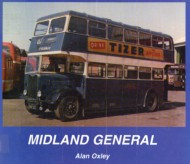
Midland General: with Notts & Derby
by Alan Oxley
1st Edition - December 1999
Publisher: Robin Hood Publishing
ISBN 094885412X
26cm x 22cm, hardback, 138 pages, B&W illustrations
Many thanks to the following for their contributions towards this page:
The following pages used to exist online
© Timebus 2002-2020